.(JavaScript must be enabled to view this email address)
Faculty
Human Geography | Environment-Society
Associate Faculty of CAS
303-492-5438 Gugg 103a
Ph.D. University of California, Berkeley, 2003
My main research interests are on questions of power, political economy, and cultural politics in the nature-society relationship. Using primarily ethnographic methods, I have conducted research on property rights, natural resource conflicts, environmental history, development and landscape transformation, grassland management and environmental policies, and emerging environmentalisms in Tibetan areas of China. In addition, I have also worked on the politics of identity and race in the Tibetan diaspora, and on several NSF-funded interdisciplinary, collaborative projects on putative causes of rangeland degradation and vulnerability to climate change on the Tibetan Plateau. Broader research and teaching interests include transnational conservation, critical development studies, the relationship between nature, territory, and the nation, and environmental justice. My regional expertise is in China, Tibet, and the Himalayas.
Yeh, Emily T. (2012). Transnational environmentalism and entanglements of sovereignty: The tiger campaign across the Himalayas. Political Geography 31:408-418 .
Yeh, Emily T. and Gaerrang. (2011). Tibetan pastoralism in neoliberalizing China: Continuity and change in Gouli. Area 43(2): 165-172.
Yeh, Emily T. (2009). Greening Western China: A critical view. Geoforum. 40:884-894.
Yeh, Emily T. (2009). From wasteland to wetland? Nature and nation in China's Tibet. Environmental History 14(1): 103-137.
Yeh, Emily T. (in press). Blazing pelts and burning passions: Nationalism, cultural politics and spectacular decommodification in Tibet. Journal of Asian Studies.
Publications updated August 2012
Spring 2013 GEOG 2412 (3) Environment and Culture
![]() |
Galen Murton |
Ph.D. | development; political geography & ecology; Tibet & Himalaya region; international | |
![]() |
Lindsay Skog |
Ph.D. | Intersection of belief systems, landscapes, & conservation in high Asia | |
![]() |
Michelle Stewart |
Ph.D. | Environmental Conservation and Economic Development in China; Sustainable Management | |
![]() |
Elizabeth Wharton |
Ph.D. | China's development role in the Horn of Africa | |
![]() |
er rang Ga |
Ph.D. | Alumni 2012 |
Alternative Development on the Tibetan Plateau: The Case of the Slaughter Renunciation Movement |
![]() |
Abby Hickcox |
Ph.D. | Alumni 2012 |
Open Space? Environmentalism and the Politics of Belonging in Boulder, Colorado |
![]() |
YundanNima YundanNima |
Ph.D. | Alumni 2012 |
From 'Retire Livestock, Restore Rangeland' to the Compensation for Ecological Services: State Interventions into Rangeland Ecosystems and Pastoralism in Tibet |
In 2009, I received an NSF Career grant, “Culture and Conservation: Transnational environmentalism, sacred lands, and community organizations in Tibet,” which provides funding for five years to investigate the intersection of transnational conservation projects, China’s environmental movement, and Tibetan culture in the articulation of Tibetan environmental identities and the formation of Tibetan environmental groups. As part of the educational component of this grant (and with additional funding from National Geographic), in 2010 I produced a 20-minute educational film entitled “Shielding the Mountains,” about Tibetan cultures of nature, and China’s environmental movement. This film was designed for use in classes such as the one I teach on Environment and Culture, as well as more broadly for high school and undergraduate classes in environmental studies, geography and anthropology to teach about environmental movements, indigenous knowledge, sacred landscapes, ideas of nature, China, and Tibet.
I continue to work on two other NSF-funded grants with my graduate students, including one on climate vulnerability on the Tibetan Plateau, particularly looking at herders’ differential vulnerability to snowstorms, and the other a comparative look in two sites on the plateau at rangeland management practices and their relationship to grassland productivity, to address the question of putative causes of rangeland degradation.
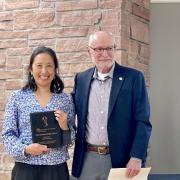
I also received the 2010 Leopold-Hidy prize, for best article published in the journal Environmental History (in 2009), for my article, “From wasteland to wetland? Nature and nation in China’s Tibet.” Finally, I’ve been working very hard at a book manuscript about how development and state incorporation have worked through and upon the material landscape in Tibet from the 1950s to the present. The book manuscript is current entitled Development as Gift: State Incorporation and Landscape Transformation in Tibet, and develops an analytic of development as gift, which stresses the contradictions and ambiguities of development as a hegemonic project. It is based on more than 16 months of fieldwork over eight trips to Tibet between 2000 and 2009.
"What's New" updated February 2011
Jul 2010
Emily Yeh Quoted in New York Times Article Regarding Chinese Migrant Workers in Tibet
Apr 2010
Emily Yeh Using ARRA Funding to Study Environmentalism in China and Tibet
Apr 2010
Emily Yeh promoted to Associate Professor with tenure
Feb 2010
Emily Yeh wins 2009 Leopold-Hidy Prize
Feb 2010
Emily Yeh Chosen as a Center for the Humanities and Arts Fellow for 2010-2011 ‘China’ seminar
Despite living in Colorado and doing research in Tibet, I love the ocean and try to scuba dive when I get the chance. Fortunately, I also enjoy biking and hiking and most of all, playing capoeira, a Brazilian martial art. Most of non-work time, though, is spent playing with my son Osel and daughter Seldron.